
It's Chekhov's world and we're just living in it
A beginner's guide to Chekhov's short stories

Earlier this year, I was infected with an obsession. I wanted to understand the short stories of Anton Chekhov.
It isn’t that his language is convoluted. Few writers write in such consistently simple prose shirking any metaphor or exaggeration that draws attention to itself. His themes aren’t inaccessible either. You don’t need a prior knowledge of Schopenhauer or a deep familiarity with the Bible to grasp his work. These are simple stories written with plain clarity, going from point A to point B:
A child crosses the Russian grasslands in a wagon convoy to join a boarding school.
A father struggles to explain to his 7-year-old son why smoking is wrong.
A young military officer is accidentally kissed by somebody in a dark room and becomes obsessed with the event.
A bored judge and distracted lawyers try an alleged murderer in a lazy courtroom.
A teenage girl filled with longing after watching a romantic play has nowhere to put it.
A servant girl who has just lost her father is dying to sleep, but forced to stay awake.
A lazy doctor starts showing compassion to asylum inmates, without foreseeing the consequences.1
He wrote more than 500 of these short stories. These stories influenced writers like Raymond Carver and Ernest Hemingway, who went on to influence generations of writers. And yet, it’s hard to explain what sets apart Chekhov, who is considered one of the greatest writers of all time.
It’s that resistance to analysis that baffled me. Every great writer is great at multiple things, but they’re recognized for something. Tolstoy had this incredible talent for creating moral masterpieces that asked big questions, filled with nuanced characters and vivid set pieces. Turgenev mastered the character of the Russian peasant: he evoked admiration for their simple lives and a horror for the system that crushed them. Dostoevsky’s frenzied rants cut deep into the darkness of the psyche, and Gogol’s deranged idiosyncratic voice conjured a bizarre world. But Chekhov…
Chekov’s writing is like sea water that slips through clenched fingers. But it leaves the taste of salt on your palm. It’s the sound of a faint melody from a different room, a soft fragrance in the evening breeze. The after-effect of reading a Chekhov story lingers for ages, but it’s hard to verbalize or to communicate.
That doesn’t mean I can’t try. I read as many stories by him as I could over the last few months, and this post is about everything I discovered. At the end of the post is a reading list to introduce you to Chekhov’s world.
The making of a writer
The key to Chekhov’s stories is to start with the man and walk along.
Anton Chekhov was born in the small port town of Taganrog in Russia in 1860. He was the third of six children, to a kind mother and a physically abusive father whose father had been a serf.2 When his father’s business went bankrupt around 1885, the family was broken. Chekhov tutored an acquaintance’s children in exchange for room and board. He studied to become a doctor, and began writing comic stories on the side to earn some extra money for the family around the age of twenty.


Writing was just a side hustle at the beginning. A lot of his earlier stories were formulaic. For example, in “The Death of a Government Servant,” a lowly clerk feels anxious after he sneezes on a higher official at a theatre. He repeatedly tries apologizing over the next few days until the annoyed official snaps at him, after which the clerk promptly goes home and drops dead on his sofa (This feels like a parody of Gogol’s “The overcoat”). Stories like “The Slanderer,” “A work of art,” and “A play” follow a similar pattern. They’re fun but forgettable one-note jokes.
In 1886, Chekhov got a letter that changed his life. The writer-critic Grigorovich wrote telling him that he had a gift and that he should approach literature with more seriousness. Chekhov responded with: "Your letter... struck me like a flash of lightning. I almost burst into tears, I was overwhelmed, and now I feel it left a deep mark on my soul." Two years later, Chekhov published “The Steppe,” which he called “something rather odd and much too original.” It was his first major work of serious literature.
When stories become music
The Steppe is the story of Yegorushka, a little boy traveling from his village to a distant town through the Russian Steppe (grasslands), meeting a variety of different characters on the way. This is a boring and sleepy story for the most part, in which nothing much happens. But after reading it, I found many photographic images from the story bubbling up in my memory as though I had actually witnessed them. For example:
To while away the time Yegorushka caught a grasshopper in the grass, held it in his closed hand to his ear, and spent a long time listening to the creature playing on its instrument… The two boys stroked the grasshopper's broad green back with their fingers and touched his antenna, supposing that this would please the creature. Then Deniska caught a fat fly that had been sucking blood and offered it to the grasshopper. The latter moved his huge jaws, that were like the visor of a helmet, with the utmost unconcern, as though he had been long acquainted with Deniska, and bit off the fly's stomach. They let him go. With a flash of the pink lining of his wings, he flew down into the grass and at once began his churring notes again. They let the fly go, too. It preened its wings, and without its stomach flew off to the horses.
This microscopic attention to the smallest moments is a signature of Chekhov. He considers nothing unimportant. There is no larger point to this image in relation to the rest of the story; and yet it lingers in the mind, as does the image of Yegorushka being frightened when he sees a giant walking toward him through the rain illuminated by lightning, only to realize it is a peasant with a sackcloth over his head; or him pocketing a cake at the beginning and discovering a soggy mass later. The entire story is told from the point-of-view of the boy. While the boy’s sensory experience and perceptions are vivid, his verbal interaction with other characters is childish, giving an amazing glimpse into the gap between a child’s perception and expression. There are worlds in there we know nothing of.
The Steppe was “the dictionary of Chekhov’s poetics” according to Michael Finke, creating a toolbox that he would go on to enrich and develop.3 After the success of The Steppe, Chekhov never looked back, venturing deeper into serious literature. His stories after this period grew increasingly more subtle and artistic.
But what is it exactly that sets apart a Chekhov story?
Stories are memetic organisms that travel by word-of-mouth. People compress the most memorable part of the story into a few words and retell it to others. If they’re successfully infected, the story has a chance of spreading and going viral. Bards and storytellers were superspreaders before the invention of writing, and some types of stories spread better than others: stories with a twist ending, fantastic premises, grotesque characters, and spectacular events.4 These memorable parts were compressed into memes that would carry forward the story and be easily recalled in discussion. “The Monkey’s Paw” becomes a story whose short-hand is just “be careful what you wish for.”
Chekhov’s stories have none of the fantastic aspects that aid meme-ification. They’re as plain as plain can be. And yet they have lasted. How? I think the answer is that these stories are more similar to music than they are to literature. They’re all about mood, atmosphere, immersion, and evoking a feeling that cannot be compressed. You don’t ask somebody to summarize a song or quote its highlights when they recommend it. A song is meant to be heard and experienced. Similarly, a Chekhov story is meant to be read, not retold.
Chekhov knew this. In one of his stories, “The Kiss,” a young officer named Ryabovitch who has never had a romantic relationship wanders into a dark room at a party and is kissed by a woman who smells of lilac.5 It’s an accident, and the startled woman escapes. But the event becomes an obsession that completely consumes Ryabovitch’s imagination, with him spending days wondering about the young woman’s identity, exploring his own feelings, and imagining his future. Bursting with excitement, he finally tells a couple of his friends about the encounter, and this is how Chekhov describes it:
He began describing very minutely the incident of the kiss, and a moment later relapsed into silence… In the course of that moment he had told everything, and it surprised him dreadfully to find how short a time it took him to tell it. He had imagined that he could have been telling the story of the kiss till next morning.
Chekhov is aware that the masterpiece would be reduced to a trivial anecdote. He is also aware that the inner intensity of every person shines with vividness, but to translate it into an engaging story, it needs a writer. And it needs the written medium. These stories were meant to be read alone, in the privacy of your room and in the recesses of your mind, not read aloud to an audience. Like listening to a song, you have to trust the recommendation and actually take the plunge to feel the effect.
An appetite for characters
Chekhov’s world began to widen, and so did his appetite for characters. As his popularity began to grow, all kinds of people began to visit him and talk to him, feeding his curiosity to learn about the lives of other people. He was invited to stay in the houses of socialites with whom he struck up friendships, and writing plays brought him into contact with the Moscow Art Theatre. He also traveled quite a bit — to Ukraine, to France, to the penal colony of Sakhalin — and drank in sights that enriched his stories.
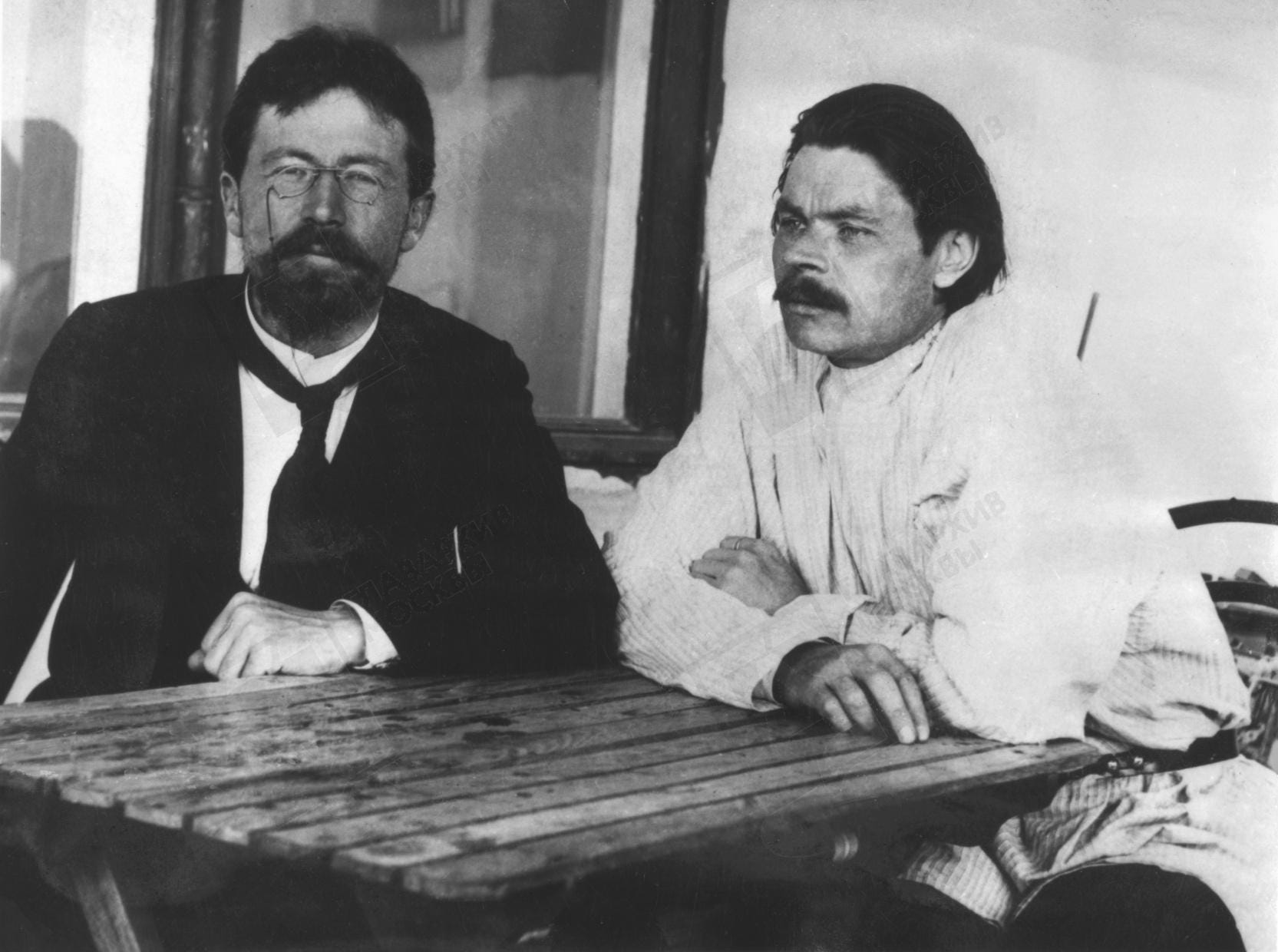
Something that repeatedly comes up in how his friends remembered him was how simple and unaffected he was in his interactions with all kinds of people. Chekhov’s friend Maxim Gorky writes that once, three ladies visited him and attempted to engage him by asking him questions about “serious” topics, like the war, which he kept dodging:
How will the war end? “Probably in peace”
Who will win? The Greeks or the Turks? “Those will win who are stronger”
Who do you think are stronger? “Those who are better fed and educated”
Finally, he looked at one lady and said, “I love candied fruits. Don’t you?” “Very much!” said the lady, and the serious atmosphere turned into one of levity. The three begin to talk with great interest and subtle knowledge about candied fruit, even promising to send him some when they left. As Gorky smiled and said, “You managed that well,” Chekhov laughed and replied:
“Every one should speak his own language.”
This was probably his guiding principle when he wrote short stories. Unlike Gogol, Dostoevsky, Fitzgerald, or Lovecraft, there is no “Chekhovian” voice that flavors his prose. In fact, his prose is distinctive for the absence of any ornamentation.6 What is common to all his stories is his philosophy of “letting the characters speak their own language.” He was a glutton for the stories and lived experience of the people he interacted with.
There may have been another factor contributing to his passion for writing. Around 1884, Chekhov developed symptoms of tuberculosis and the disease slowly ate at him for the rest of his life. Though he never complained, his friend and writer Ivan Bunin once heard him express wistfully: “It must be nice to be a soldier, or a young undergraduate, to sit in a crowd and listen to a band…” There were lives he could not live firsthand, as a husband, as a father, as a traveler, as a family man who grew old, and his stories might have given him the opportunity to live these lives, vicariously.
Chekhov and Tolstoy
Late in his life, Chekhov wrote a short story, “The lady with the dog.” A middle-aged Moscow man named Gurov meets a young lady with a dog at Yalta, a holiday retreat. They have a brief fling after which they part ways. But for the first time in his life, the man is unable to forget a casual affair, and he goes looking for her. It’s a very simple story, but what makes it stand out are the details. This is how Gurov’s wife is described: “She was a tall, erect woman with dark eyebrows, staid and dignified, and as she said of herself, intellectual. She read a great deal, used phonetic spelling, called her husband, not Dmitri, but Dimitri, and he secretly considered her unintelligent, narrow, inelegant, was afraid of her, and did not like to be at home.” A portrait in just two sentences!
Later, after Gurov is pining over Anna (the young lady) in Moscow, he blurts out to a friend that he met someone fascinating in Yalta. Just as the friend is driving away, he turns and shouts:
“Dmitri Dmitritch!”
”What?”
”You were right this evening: the sturgeon was a bit too strong!”
These words, so ordinary, for some reason moved Gurov to indignation, and struck him as degrading and unclean. What savage manners, what people!
What sticks out here is the specificity of these characters, and the details that make them up. Whether he was treating children as a doctor, interviewing convicts, socializing with nobles, or moving in theatre circles, he was always collecting details and characters that would populate his stories. As the critic James Wood notes7, he carried a notebook, “the mattress in which he stuffed his stolen money. It is full of enigmas in which nothing adds up, full of strange squints, comic observations, and promptings for new stories.” Some details:
The dog walked in the street and was ashamed of its crooked legs.
They were mineral water bottles with preserved cherries in them.
He picked his teeth and put the toothpick back into the glass.
A private room in a restaurant. A rich man, tying his napkin round his neck, touching the sturgeon with his fork: ‘At least I’ll have a snack before I die’ — and he has been saying this for a long time, daily.
If you wish women to love you, be original; I know a man who used to wear felt boots summer and winter, and women fell in love with him.
But Chekhov was not interested in symbolic and poetic details, only in specific and seemingly inconsequential ones. Celine Nguyen, in her essay “mere description” said:
“Even a functional description can, in the details it includes and the specificity of those details, become beautifully expressive. That’s what great description does: it compresses a highly unusual, highly idiosyncratic point of view into the smallest observations about the world. Writing might begin with mere description. But really great, moving writing rarely contains itself to the mere.“
This mere description is what Chekhov excelled at. He populated his universe with these characters and details, showing real people doing real things, and these small specific things become a more real and authentic portrait of them than any commentary or clever line from the author could be. This is one of the things that’s special about reading a Chekhov story. In the most unsuspecting moment, he can mention a fact that catches the reader off-guard, showing a mirror to their humanity.
This is very different from how his contemporaries used detail, especially Tolstoy. Consider the scene in Anna Karenina where Anna and Vronsky have made love for the first time:
“My God! Forgive me!” she said, sobbing, pressing his hands to her bosom.
She felt so sinful, so guilty, that nothing was left her but to humiliate herself and beg forgiveness; and as now there was no one in her life but him, to him she addressed her prayer for forgiveness. Looking at him, she had a physical sense of her humiliation, and she could say nothing more. He felt what a murderer must feel, when he sees the body he has robbed of life. That body, robbed by him of life, was their love, the first stage of their love. There was something awful and revolting in the memory of what had been bought at this fearful price of shame. Shame at their spiritual nakedness crushed her and infected him. But in spite of all the murderer’s horror before the body of his victim, he must hack it to pieces, hide the body, must use what he has gained by his murder.
See how Chekhov handles the same situation in “The lady with the dog,” through the eyes of Gurov:
The attitude of Anna Sergeyevna — “the lady with the dog” — to what had happened was somehow peculiar, very grave, as though it were her fall — so it seemed, and it was strange and inappropriate. Her face dropped and faded, and on both sides of it her long hair hung down mournfully; she mused in a dejected attitude like “the woman who was a sinner” in an old-fashioned picture.
“It’s wrong,” she said. “You will be the first to despise me now.
There was a water-melon on the table. Gurov cut himself a slice and began eating it without haste. There followed at least half an hour of silence.
After this follows a monologue from Anna, very similar to the one given by Anna Karenina, and this is what follows:
Gurov felt bored already, listening to her. He was irritated by the naïve tone, by this remorse so unexpected and inopportune; but for the tears in her eyes, he might have thought she was jesting or playing a part.
“I don’t understand,” he said softly. “What is it you want?”
Hilarious, and yet true to life. Being Anna Karenina and Vronsky sounds poetic even if its tragic. Water-melon eating Gurov just feels plain wrong. And yet, that’s how we act in privacy, because the intimate spaces in real life aren’t constantly illuminated with the spotlight of literature. Chekhov’s characters too behave naturally, as if they aren’t being watched.
Tolstoy’s characters and Chekhov’s characters both act true to life. Anna and Vronsky act true to a vision that Tolstoy has in mind for them. Tolstoy’s characters inhabited a world written to his moral design — he was exploring the question of the moral life, and his characters were colored in his shades. Chekhov’s characters are true to their life. They act according to their whims, behave consistently with their character, and speak in their own voice.8 If Chekhov was the God of his universe, his maxim would be: God proposes, and man disposes. And like an all-loving God, Chekhov observes each character with complete empathy, paying close attention without judging any of their actions.
The connection between Anna Karenina and Chekhov’s story isn’t accidental.9 Chekhov loved the novel and was obsessed with it for 6 to 7 years, developing great respect for Tolstoy. He positioned himself in relation to Tolstoy, but in an orthogonal manner. Tolstoy was trying to answer the question: If a woman who has everything is prepared to risk it all for the sake of love, is it worth it?
Chekhov took that big question and splintered it into several questions, each producing its own story:
What happens when an aging aristocrat with cynical and rigid morals is stuck in a loveless marriage with a beautiful young woman who is compassionate and philanthropic? (The wife)
What happens when a man falls in love with a young woman who is married to an old man, and he is friends with the woman and her husband? (About love)
What happens when a charming philanderer starts a casual relationship with a young woman and they both fall deeply in love? (The lady with the dog)
What happens when a sensitive and artistically inclined woman marries a simple and virtuous doctor who does not mingle well with her social circle? (The grasshopper)10
What happens when a man finds out his wife is cheating on him and decides to take the moral high ground, but the confrontation goes in a way he never expects? (The helpmate)
What happens when a woman’s old husband and young paramour are close friends? (The two Volodyas)
What happens when a decadent man finds out that the husband of his mistress has just died, and instead of wanting to marry her, he wants to flee? (The duel)
While Tolstoy wanted to find the definitive answer, Chekhov set the problem in the middle of the room and walked around, looking at it from different angles and chronicling what he saw. He famously said that “The task of a writer is not to solve the problem but to state the problem correctly.” There is no “right” character or fate in Chekhov’s stories – all his characters are equally worthy of his attention, and their fates seem inevitable based on their personalities and the situation they are in.
It felt like Chekhov was always messing with Tolstoy on some level. In “Home,” a father manages to successfully trick his seven-year-old son into giving up smoking through perfectly manipulative storytelling, after which the father feels guilty about his terrible power. It feels like a dig at Tolstoy’s effective moral storytelling (and yet, “Home” was one of Tolstoy’s favorite stories). In “The death of Ivan Ilyich,” Tolstoy examined the existential crisis faced by a man confronting terminal illness, and he stated an answer at the end. Chekhov took literally the same premise and wrote “A dreary story” a few years later — he ended the story with a sense of complete emptiness and cynicism, just as if to show that sometimes there are no easy answers in life.
This wasn’t antagonism for the sake of it. The two writers had different concerns.
Death was a favorite preoccupation of Tolstoy’s. In many of his stories,11 characters face imminent death at the end and they either experience salvation or succumb to a tragic death. But Chekhov was interested in the living: what happens when death happens around you, and you need to go on living? In a beautiful short story named Misery, a cab driver who has lost his only son keeps trying to tell one passenger after another about his sorrow, but nobody wants to listen. It is this mundane sorrow that Chekhov confronts.
Life does not end after tragedy or bliss: the question is, how do you wake up in the morning and keep moving on? Why look for salvation or damnation in the face of death, when every living day is a possibility? It feels like Chekhov’s characters have a life that spill out beyond the last pages of his stories, and all he has done is capture a glimpse into a specific moment.
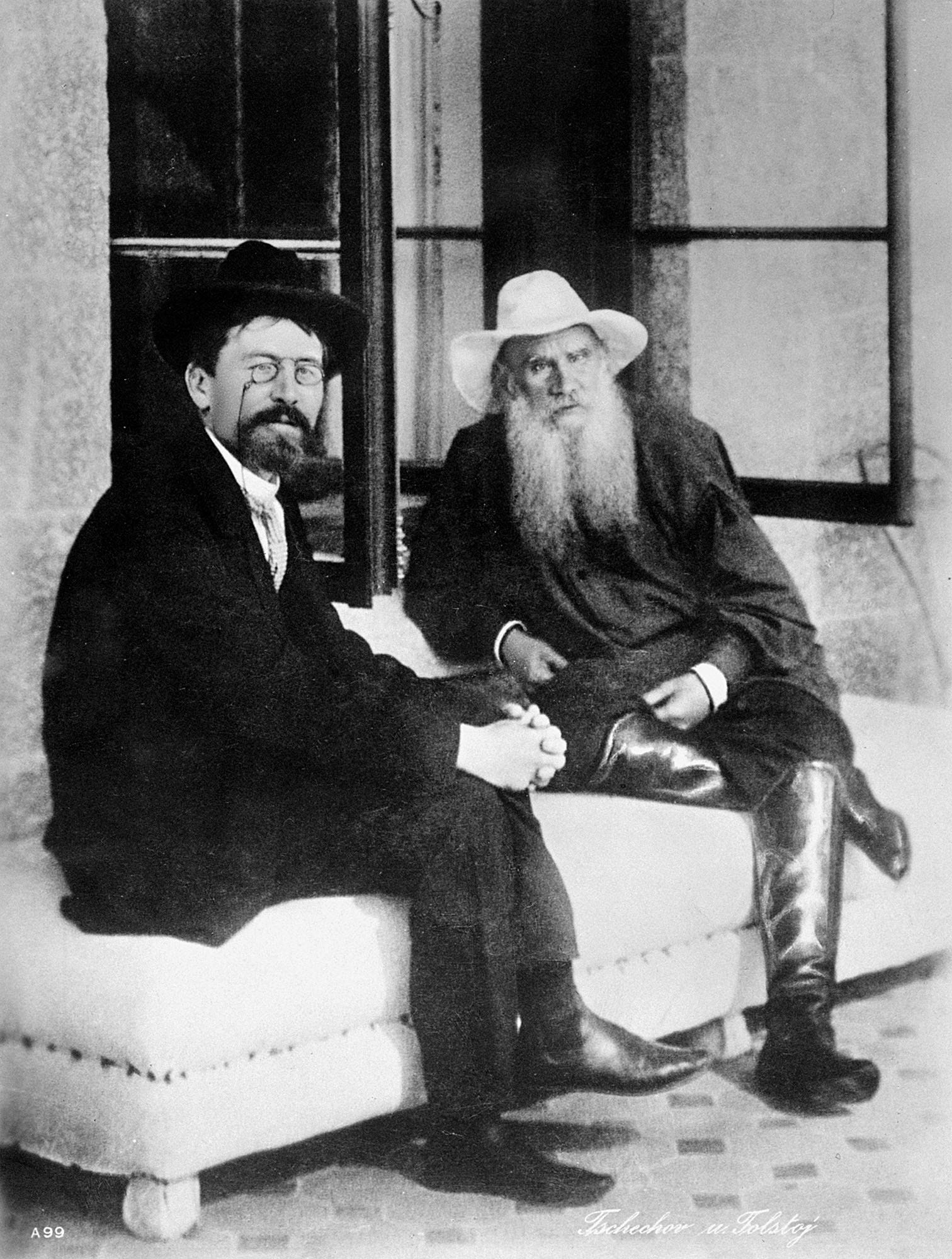
Tolstoy was an early admirer of Chekhov’s,12 and the admiration was mutual. The two eventually became friends, visiting each other and even swimming together on Tolstoy’s estate (which might have inspired Chekhov’s story “Gooseberries”).13 Despite admiration for his talent, Tolstoy and others criticized Chekhov for not having a definite moral or political consciousness in his fiction.
Morality in banality
Chekhov was very wary of isms. He didn’t want to be associated with either the right or the left (though both claimed him at different times), and he rarely shared his opinion on political views, in public or in private. There were two exceptions to this:
During the Dreyfus affair in France, when a Jewish French officer was wrongly convicted of treason, Chekhov publicly spoke for Dreyfus while condemning anti-semitic virulence. This fractured his relationship with Suvorin, one of Chekhov’s oldest and closest friends.
Chekhov’s insistence on the fact that Russia needed to take better care of its teachers and doctors who toiled away silently under harsh conditions. Stories like “The wife,” “Ward No. 6,” “The runaway,” and “In the cart” capture this preoccupation.
But despite his reticence, Chekhov’s fiction did have a definite moral consciousness. He was a scientist of habit. Chekhov’s stories do not compress tension into one critical decision or moment of revelation. Instead, they reveal character slowly, at every inflection point in the story. He seems to be saying: “The big choices that people make in grand moments don’t matter next to the small choices that add up every day. Every day is a trial. You don’t know which moment will turn out to be important.” He preferred to study what Frank O’Connor called “venial sin” instead of looking at “mortal sin.”14 The small questions instead of the big questions. Real people don’t get ruined in one fell swoop, and neither do Chekhov’s characters.
In the story “A problem,” we are admitted into the conference room of an aristocratic family where one uncle is passionately pleading for the forgiveness of a wayward nephew who has forged a note. Other relatives are less moved. It is obvious that this young man has been at it for quite some time, and he is shown sitting outside, thinking that he is obviously not a criminal and that he could be sent to prison or to Siberia for all he cared. Finally, the joyous uncle tells him he is free to go and as they walk out into the street, the nephew remembers a friend of his has a birthday party. “Give me hundred roubles!” he tells the shocked uncle, “Or I’ll turn myself in!” As the uncle fumbles in his pocket, the nephew thinks, yes, I am a criminal now.
This is not Dostoevsky exploring the question of murder, but rather about the multiple cuts we inflict on the people we love every day. It’s about the General who preaches ideals yelling at his child and taking his wife for granted at home. Chekhov keenly observed the hypocrisies of people, and he poured them into his characters, all while withholding contempt. Over time, this led to the creation of two uniquely Chekhovian characters – the ineffectual dreamer and the heartless visionary. Sometimes these two characters would clash.
In his famous novella, “The Duel,” we are introduced to two characters: Laevsky and Koren. Laevsky is a charming young man living with another man’s wife on borrowed money. He is a great talker and makes for very good company, but just loafs around. Koren is a practical and diligent zoologist, a man of precision and ruthless ideas who believes only in economic productivity and the survival of the fittest. The story is about a personal conflict between the two men which is also a moral battle under the surface. It is the story in which Chekhov comes closest to actual philosophy when a different character says: “faith without works is dead, but works without faith are worse still, merely a waste of time and nothing more.”
The conflict shows up again in “The Wife,” and again in “The cherry orchard.” It seems to be a central theme that Chekhov was wrestling with all his life. Laevsky and Koren might just have been two sides of himself that he was trying to reconcile. He was the artistic writer dreaming of private worlds and he was also the practical man of science treating patients in Russian villages. He might have hoped for a world where both these aspects were in harmony, in all people.
Nabokov says, in his lecture on Chekhov:
Chekhov’s intellectual was a man who combined the deepest human decency of which man is capable with an almost ridiculous inability to put his ideals and principles into action; a man devoted to moral beauty, the welfare of his people, the welfare of the universe, but unable in his private life to do anything useful… it is the stumble of a man who stumbles because he is staring at the stars.
Despite imagining such a type of ineffectual intellectual, Chekhov was not one himself.


Chekhov is remembered by all who knew him as a kind, gentle man who worked very hard, very uncomfortable both with criticizing people and receiving compliments, generous with his time, and extremely hard-working. Despite retiring from medical practice after his writing started to pay, Chekhov was actively engaged in building and running libraries, schools, and hospitals. He was a health officer for a Zemstvo (local government), and helped deal with a cholera epidemic with no assistants, traveling miles in carriages. He did all this while he was sick with tuberculosis, and his condition grew worse with time. He was in denial of its severity the whole time, despite being a doctor, possibly to comfort those around him.
In his later years, Chekhov retired to his orchard in Yalta (now in Crimea), and had a long-distance marriage with Olga Knipper, the lead actress in some of his plays. He died in Germany while on vacation with her, and his body was carted back in a refrigerated railway carriage marked for oysters. Hundreds of people attended his funeral.
A month before he died, Chekhov told his friend Ivan Bunin that he would be read for at most “seven and a half years.” At least 122 years have passed since his prediction. Chekhov populated his fictional world with lovingly crafted characters. But that world is our world. The humanity of every character in his stories is mirrored in every reader who picks up his book. And as long as people keep reading, Chekhov will live on.
A reading guide
If you haven’t read Chekhov yet, I’ve put together a sequence that will let you ease into it. If you’ve been reading Chekhov, you’ll discover new reads here. Feel free to skip steps or mix it up. Unless otherwise mentioned, I always prefer the translation by Constance Garnett. If the story is not easily available, I’ll link to an online version:
Start with Chekhov’s joke stories. They’re fun and approachable. “Letter to a learned neighbor” (his first published story), “The death of a government servant,” “A play,” and “The slanderer” are all great. “On the sea” is bawdy and hilarious.
Read these light-hearted stories that are slightly more serious: “Home,” “In the court,” and “Agafya.”
Read “Gooseberries.” A good way to do this is to get George Saunders' book "A swim in a pond in the rain." In this book, Saunders walks you through some Russian short stories page by page, and notices the beauty you might miss because you are not used to this type of story. If you write stories yourself, I doubly recommend it. The book covers three short stories by Chekhov: "In the cart," "Darling", and "Gooseberries", all of which are great.
If you liked Gooseberries, read “The little trilogy”: “The man in the case,” “Gooseberries,” “About love.”
Read three of his more conventional stories: “The Bet,” “Enemies,” and “A nightmare.” These are high on drama, and have a satisfying payoff.
Read three of his more subtle stories: “The lady with a dog,” “The kiss,” and “Volodya.”
Now try something more ambitious. Watch the movie “Winter Sleep,” a Turkish film by director Nuri Bilge Ceylan, based on Chekhov’s novella “The wife.” This movie gives you a visual grammar to understand Chekhov’s world. In fact, I didn’t fully get Chekhov’s vision until I saw this film and I’m grateful to my friend who recommended it.
After that, read “The wife” by Chekhov. A few other novellas by Chekhov are also good, including “A dreary story,” “Ward No. 6.,” and “The Steppe.” They are quite long though, so you might want to save them for a rainy day.
Chekhov isn’t just capable of funny, warm, or depressing stories. He is capable of some truly disturbing stuff as well. Read “Sleepy,” followed by “In the Ravine.” In the Ravine is so different from Chekhov’s other stories — it has a noirish vibe like Dashiell Hammett’s Nightmare Town. Incredible story.
“The Duel” is Chekhov’s most philosophically ambitious novella. You’ll eventually want to read it.
Get back to reading the short stories with the awareness of Chekhov’s range and versatility. These are some great ones:
Misery
Rothschild’s fiddle
The grasshopper
Vanka
The chorus girl
The head of the family
A problem
The witch
The black monk
The helpmate
If I left out any of your favorites, let me know!
One tip that I found helpful: Give these stories some space to breathe. Because Chekhov’s prose is so simple to read, I used tom rush through the sentences and get to the end. But Chekhov was a dramatist as well. The real effect happens in the silences between the dialogues and the scenes (I understood this after watching “Winter Sleep.” George Saunders’ book is also very helpful). He describes something and breaks the line, and that description matters to the perception of what's going on. Small gestures, stares, and actions reveal the power dynamics between people. People say terse, blunt sentences, and it's only in the silence following that sentence that its cutting impact is felt. Reading the story aloud, pausing, and letting the impact sink in before moving on also worked for me at times.
I’m linking a sheet here with a list of the stories I’ve read. (Stories marked “Favorite” are ones I would reread, “Pass” are enjoyable enough to read once, “Fail” are skippable). I guess I’ll be updating this because I keep discovering new stories by him. Bookmark this post or the link to keep it handy.
If you enjoyed reading, consider sharing this with a friend. This Substack is where I write book reviews and sometimes share my short stories. Subscribe to get more:
I also wrote a post about Anna Karenina a while back. You can read it here.
In order of mention: The Steppe, Home, The Kiss, In the court, After the theatre, Sleepy, Ward No. 6.
Serfdom was like chattel slavery with extra steps. Serfs were tied to the land that they worked on, and the land was under the control of noblemen to whom they owed dues. Though not identical to slavery, the landowners had enormous control over peasants’ economic and family life. Ivan Turgenev’s short story collection A Sportsman’s Sketches is an excellent portrait of the world in which serfdom existed, and it even shifted public opinion against the institution. In 1861, serfdom was abolished under the Emancipation reform. So technically, Chekhov was born into a serfdom-free world. But practically, its ghosts remained: peasants were still economically dependent on nobles, or heavily indebted, or disenfranchised with no class parity in urban cities. Tolstoy’s Anna Karenina is set in this world, as are Chekhov’s stories. This rootless urban population grew restless and resentful, contributing to the Russian revolution in 1917 that ultimately exterminated the Russian aristocratic system.
Janet Malcolm wrote an excellent essay on The Steppe and two other stories by Chekhov. The Finke reference is through her.
In The Lonely Voice: A study of the short story, writer Frank O’Connor talks about how the modern short story with all its subtlety would be baffling to a teller of Russian folk-tales (called skaz) because it lacked “miracles” and colorful events that made it memorable. One Russian writer who carried skaz into writing was Nikolai Leskov. His novella “The enchanted wanderer” is a superbly entertaining read, in the vein of “The Arabian Nights.”
Chekhov seems to have had a mild fondness for lilacs. He mentions lilacs in 30 separate stories, and there are 83 occurrences of the word. Similarly, he is fond of mentioning crows, rooks, ravens, and jackdaws to set the mood. Yes, I was jobless enough to count.
Nabokov shared my quibble. He said: I do love Chekhov dearly. I fail, however, to rationalize my feeling for him: I can easily do so in regard to the greater artist, Tolstoy, with the flash of this or that unforgettable passage, but when I imagine Chekhov with the same detachment all I can make out is a medley of dreadful prosaisms, ready-made epithets, repetitions, doctors, unconvincing vamps, and so forth; yet it is his works which I would take on a trip to another planet. Nabokov’s lectures on “The lady with the dog” and “In the gully [ravine]” are very good. I borrowed some observations from there.
From Serious Noticing by James Wood. I have borrowed some ideas from this essay.
His ability to bend voices is magical. In “A dreary story” he writes as an old professor approaching his death (when he was just 29 at the time). In “Kashtanka”, he follows a dog’s perspective. In one of his best stories, “In the ravine,” the peasant girl Lipa who marries into a rich family cuddles her baby boy like this: “You will grow ever so big, ever so big. You will be a peasant, we’ll go out to work together!” The dreams she sees for her child are through her simple peasant eyes.
There’s an interesting paper analyzing “Anna Karenina’s hypertexts in Chekhov’s works.”
“The Grasshopper” caused a scandal. Chekhov was friends with the artist Isaak Levitan and his paramour Sofia Kuvshinnikova. Sofia was married, but her husband Dmitri turned a blind eye to the affair. Reading “The Grasshopper,” 42 year old Sofia thought the 20 year old main character Olga was based on her. Chekhov denied this (but there were quite a lot of similarities). Chekhov and Levitan had a falling out, which was repaired years later. Sofia never spoke to Chekhov again.
In these stories in particular: Anna Karenina, Master and Man, Alyosha the pot, How much land does a man need? Tolstoy also explicitly mentioned that the question of death was the most important and consequential question for an artist, in his essay, What is Art?
Tolstoy had two series of Chekhov’s stories that he deemed “First quality” and “Second quality” bound into a book. The first series is: Children, The chorus girl, A play, Home, Misery, The runaway, In the court, Vanka, Ladies, A malefactor, Boys, Darkness, Sleepy, The helpmate, and The darling; The second series is: A transgression, Sorrow, The witch, Verotchka, In a strange land, The cook's wedding, A tedious business, An upheaval, Oh! the public!, The mask, A woman's luck, Nerves, The wedding, A defenceless creature, and Peasant wives.
From “A swim in a pond in the rain” by George Saunders
The terminology is from Frank O’Connor’s “The Lonely Voice.”
"To divide men into the successful and the unsuccessful is to look at human nature from a narrow, preconceived point of view. Are you a success? Am I? Was Napoleon? Is your servant Vassily? What is the criterion? One must be a god to tell successes from failures without making a mistake."--Anton Chekhov
This was wonderful. I’ve never read Chekhov, and now I feel called to. I’ll be following your guide!